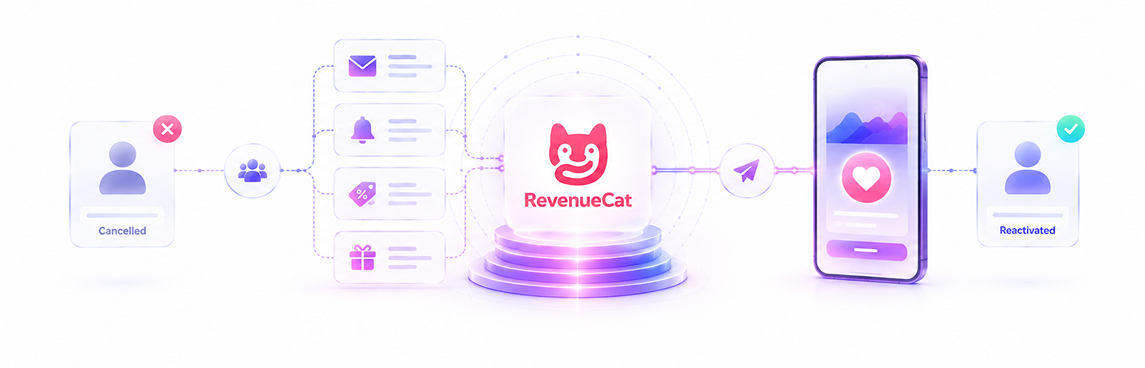
Acquisition budgets get spreadsheets, dashboards, and a dedicated owner. Win-back — reaching people who already tried the product, got value from it once, and left — usually gets nothing but a generic “we miss you” email, if that. It’s a strange gap, because a lapsed subscriber is a warmer lead than almost anyone acquisition can bring in: they already know the product, already paid for it once, and already know exactly why they left.
1. The Signals Worth Automating On
1
Voluntary cancellation vs. involuntary churn
Someone who actively cancelled and someone whose card just failed are different problems with different fixes — the first needs a reason to come back, the second just needs an updated payment method.
2
The billing-retry and grace-period window
Stores retry failed payments automatically for a period before revoking access. That window is your highest-leverage moment for involuntary churn — a simple “update your payment method” prompt recovers a meaningful share of these without any discount at all.
3
Time-since-cancellation, not just cancellation itself
A message sent the day someone cancels reads differently than one sent three weeks later, once the reason for leaving has had time to either resolve itself or calcify. Stage your outreach accordingly rather than firing everything at once.
2. Store Rules You Can’t Design Around
Allowed
Store-approved promotional offersYes
In-app messaging to lapsed usersYes
Push/email outreach (with consent)Yes
Not allowed
Charging outside store billing mechanismsNo
Circumventing store-managed cancellationNo
Both App Store and Play Store support store-approved win-back pricing mechanisms — the specific terms and eligibility rules are platform-specific and worth checking against current store documentation before you build a campaign around them, since these mechanics have changed over time on both platforms.
3. A Simple Sequence to Start From
Day 0
Cancellation event fires — log it, and if it’s involuntary (payment failure), start the retry-window messaging immediately
Trigger
Day 1
Low-pressure check-in for voluntary cancellations — asking why, not selling anything yet
Listen
Day 7
Targeted win-back offer via a store-approved promotional mechanism, if the reason for leaving suggests price sensitivity
Offer
Day 30
A final, lower-friction nudge — often just “here’s what’s new since you left” rather than another discount
Close
Don’t skip the diagnosis step
A win-back sequence built entirely around discounting treats every cancellation as a price problem, and most aren’t. Pair this with the churn data from your analytics setup before building the campaign — if churn clusters around a specific point in the product, the fix is there, not in a bigger discount.
Not doing anything with your cancelled subscribers yet?
Tell us your current churn rate and cancellation reasons (if you’re tracking them) and we’ll sketch a win-back sequence worth automating first.
Start the Conversation →