How to Brief an App Development Agency Without Wasting Your First Month
Send a two-page brief, not a feature list: the business problem, who the real users are, what success looks like in numbers, your constraints (stack, compliance, approvals), who makes decisions, what has already been tried, and an honest budget range and timeline. Then judge the agency by how it responds — a good one pushes back, proposes discovery, and names the people who will actually do the work. The rest of this guide expands each of those, and the brief template gives you the copy-paste skeleton.
The most common reason a software project fails isn’t the technology — it’s the brief. An app development agency that agrees to build without a clear shared understanding of what, why, and for whom burns through your budget on the wrong things. You end up with something technically delivered but commercially useless.
After working with dozens of founders, product teams, and internal stakeholders, here’s what a brief that actually works looks like — and the five red flags that predict a wasted first month.
1. The Seven Things Any Agency Needs to Understand
Before a single design or line of code, your agency needs to understand more than “what to build.” Context is the difference between a vendor and a partner.
2. Five Red Flags in Agency Relationships
The brief goes both ways. Here’s what to look for in the agency’s response — behaviours that signal you’ll be rewriting the contract by week three.
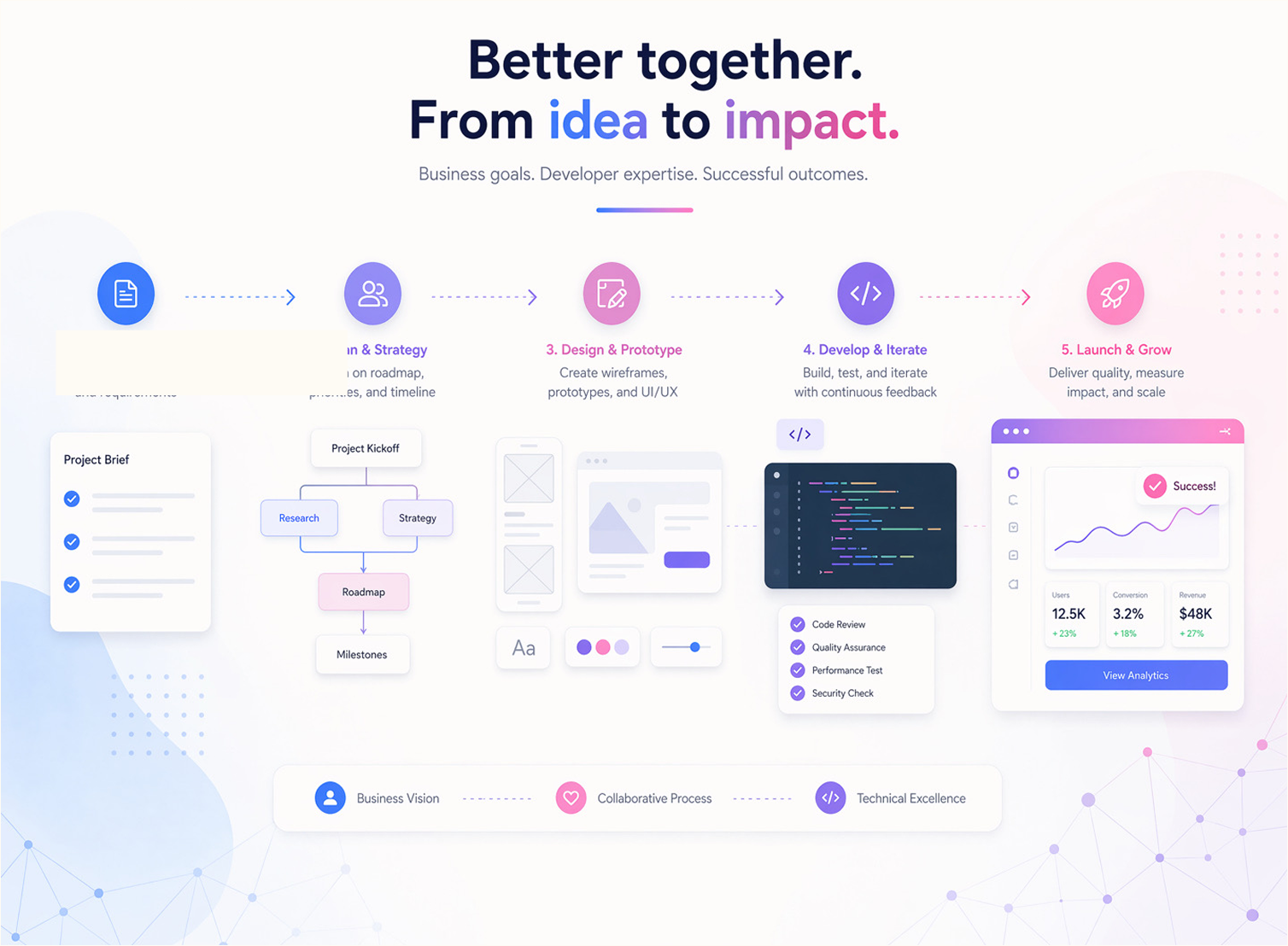
3. What a Well-Structured Engagement Looks Like
Whether you’re commissioning a full product build, a new website and digital presence, or working through the final push on an almost-complete MVP, a structured engagement has the same phases — and teams that skip any of them pay for it downstream.
Teams that skip discovery to save time typically spend 2–3× longer fixing misaligned decisions downstream. The phase that feels like a delay is the one that makes everything else faster.
If you’re preparing a brief right now, we’ve broken each stage of this process into a practical companion guide: the brief template to send before the first call, nine questions to vet an AI-assisted agency, and what month one should actually produce, week by week. Still deciding whether to hire an agency at all? In-house vs. agency lays out the honest comparison.
4. Briefing an Agency: FAQ
How long should an app development brief be?
Two pages. Long enough to cover the seven items above, short enough that every person on the agency side actually reads it. A twenty-page RFP gets skimmed; a two-page brief gets discussed.
Should I share my budget in the brief?
Yes — a range, not a number. Without it the agency is guessing at scope, and a proposal built on a guess is either padded or under-scoped. Withholding budget doesn’t lower the price; it lowers the fit.
Do I need wireframes or a spec before briefing an agency?
No. A clear problem, real users and measurable success criteria are worth more than premature wireframes. If you already have a prototype — including an AI-built one — say so and share it; it’s useful context even if it gets rebuilt.
What should I expect back from the agency after sending a brief?
Questions. A good agency responds with a discovery proposal and clarifying questions, not an instant fixed quote. Silence, or a price with no questions attached, is the first red flag above.
Briefing with a vibe-coded prototype? “Here is the working app and here is where it broke” is an excellent brief — see vibe coding vs hiring a developer and what to do when your vibe-coded app breaks for how to package it.
Related: what investors and enterprise customers will ask about an AI-built product, and what a rescue engagement costs.
Ready to brief us?
Start with a conversation, not a document. Tell us the business problem you’re trying to solve and we’ll tell you what a structured, honest engagement looks like for your specific situation.